Thursday, April 20, 2017

#56 - Jose Tartabull of the Boston red Sox


Up next is someone who I grew up thinking of as just Danny Tartabull's father. The New York Yankees slipped into irrelevancy in 1989 and fell even further in 1990 with Steinbrenner's temporary ban/suspension/agreement for his involvement in the Spira affair centered on Dave Winfield. The Yankees were slowly developing young talent but still were fishing in free agency for players. After replacing Winfield with Barfield didn't work out, they tried Danny Tartabull and he did for 4 strong years. His production numbers remained respectable though his batting average dropped from its peak. In alot of ways, Danny Tartabull is the forgotten New York Yankee. The team was becoming relevant but were in the shadow of the Toronto Blue Jays. The '94 strike year also diminished the Yankees on that team that were not around in '96 for their championship run. Luis Polonia, Steve Farr, Steve Howe, Mike Stanley, Matt Nokes, and Danny Tartabull aren't names as readily remembered by Yankee fans.

Jose Tartabull wasn't the power hitter his son turned out to be , in fact he has two home runs in his career. Tartabull however was a gifted base stealer and a valuable utility player in the outfield. He went on to see action in all 7 World Series games in 1967. His pro career began when he was 19 in the Giants farm system and ended in the Athletic's farm system when he was 33.

I like the look of this card. It's a picture taken in Yankee stadium, Tartabull in this pose takes up alot of space within the borders, and the orange lettering compliments the look of the Red Sox uniform well in this setting. The cards with Sox players photographed in Spring Training with the yellowish looking grass aren't as striking to the eye. It's the grass that does it I think.

Wednesday, April 19, 2017

#55 LA Dodgers HOFer Don Drysdale

 Next up is 5 card. Topps saved their biggest star cards for cards ending in 5 or 0 and this time it's Don Drysdale whose Major League career speaks for itself. Miuch like Sandy Koufax, and Carl Erskine in the 50's, Drysdale saw alot work and it took its toll on his arm. So much so that all three had careers end in their early 30's. It is unheard of today having starters appear in over 40 games in a season. Drysdale did it 5 seasons in a row. It paid off for the team since they won 2 titles during that stretch. He was an 8 time all star, led the majors in strikeouts 3 seasons and had a 3-3 record in the World Series. You could make an argument that Drysdale's arm began to give out in '66. The Dodgers won the pennant but he still had a losing record and was 0-2 in the World Series with a 4.50 era against the Orioles who sailed to a championship in a sweep.
I had an opportunity to get Drysdale's autograph at a card show on Rt 27 in New Jersey. My parents opted to get the Duke of Flatbush's autograph and I was thrill to meet him. Drysdale wasnt as high a priority as the man who hit the most home runs of anyone during the 1950s. Drysdale however died about 5 years after that card show of a heart attack. I never had the opportunity to meet him again. Him doing shows, especially in New Jersey turned out to be rare given his busy broadcasting career.

The card itself looks great for the set. The Dodger card have that great red lettering which implies they are America's team with the red superimposed against the white and blue of the Dodger jersey. I believe the photo is from Shea Stadium but I could be mistaken. It's not an angle you can clearly identify which stadium it is. Visiting teams occupied the 3rd base side dugout so it makes sense where the picture is taken. Shea Stadium was easier to identify after it was renovated in the mid 80s.

#54 Dick Green Kansas City Athletics - Those Minty Green cards

 I'm sure this isn't the time to rant but I must say, the Athletic cards in this set are the blandest most unremarkable cards possible and Dick Green's card is the starkest example of how bland they are.

You have the light blue lettering against the uniforms which themselves are mostly grey and maybe a shade darker than winter green. Truly unremarkable. Compare this to some of the cards with vibrant lettering like the bright red of the Dodgers or Yankees or the YELLOW on the Orioles. Was Topps planning to do that? Make the player cards on the prominent teams of the era stand out over the lesser teams?

The Athletics were definitely a lesser team who hadn't managed a winning season since the Mack family owned it in 1952, It was after Finley moved the team to Oakland that the franchise began to win again. The Athletics did not have a single winning season in Kansas City.Their best season was in '58 with a 73-81 record.

The history of how the Athletics came to end up on KC is worth researching. Here is a brief summary. The Mack family failed to adapt to the changes in Major League Baseball during the Depression and the war years. After the war ended in '45, other teams were more prepared to bring a competitive team back to the field, the Athletics, still reeling from their money troubles before the war floundered. The Mack family ultimately was forced to give up their team to former Yankee executives who I believe maintained a strong tie to the Yankee franchise. It was such a strong tie that the Athletics seemed like a Yankees triple A team that happened to be in the Majors. Players that could fill a hole in the Yankee lineup came from the Athletics and when the Yankees ran out of room for someone or was shipping someone out at the end of their career, he ended up in KC. The Yankees got Hector Lopez, Roger Maris, and Bobby Shantz from the Athletics.They shipped out and later brought back Enos Slaughter from KC. They sent Hank Bauer, Billy Martin, Norm Siebern and Jerry Lumpe out to KC when they were done with them. People have tried to debate that these transactions actually benefited the Athletics more than the Yankees but I look at the records. The Yankees appeared in 9 World Championships while the A's were in KC, winning 4 of them and the A's never had a single winning season. The A's started to keep their young talent when Charlie Finley took over the team and this started to pay off only after he moved the team to Oakland but it wasn't until the Royals in 1971 that the people of KC got to see a winning MLB franchise.

Dick Green was one of those young prospects the Athletics were fully planning to keep around and they did during the entirety of his Major League career. Green was one of those utility players who saw action from 1st to 3rd and even catcher on rare occasions. His career batting average of .240 was good but it's his career fielding percentage of .983 that made him indispensable to the A's. He saw action all three of their World Series championships from '72 to '74.

Sunday, March 5, 2017

1955 Bowman #97 Johnny Podres Photo Variations?


This is obviously not 1967 Topps set related but this really has been bugging me. Are there photo variations in the '55 Bowman set or is this a printing issue? I don't own the specific cards pictured here but I do have the two cards with the two differences. Podres on the top is looking toward the camera and Podres on the bottom looks to be looking well over it.

I never noticed it before last night because I never owned two at the same time before and I tried to consult a bonafide expert in the field but learned he passed away last January so, anyone out there with info. Please comment. Given the value of error cards in the Bowman set, I am not expecting much in the way of value difference but if this is a sign of a characteristic in the Bowman set, it could open the door to other variations.

#53 Philadelphia Phillie Catcher - Clay Dalrymple

 Up next is long time Phillie catcher, Clay Dalrymple. Dalrymple had regular work with the Phillies from '61 to '68 before being a backup Catcher on the Orioles from '69 to '71. He has a 1.000 batting average in World Series play. Going 2 for 2 in the '69 World Series.

His career batting average remained in the low to mid ,200s with some power. His fielding was considerably more impressive with a career 49% caught stealing percentage. That's equal to Yogi Berra's percentage.

The card has a good friend. The bright red hat stands out, the cold blue eyes, the yellow lettering and especially the field in the background all adds up to a good looking card. Typically, you just see massive sky in the back, here, you have a good shot of the stands, and the left field foul line. A nice break from the standard images used.


'Dimples' was featured regularly in Topps sets from '60 to '71. His rookie is a high number which carries some value. While he never made it to an all star game, he no doubt developed into being a fan favorite in Philadelphia.

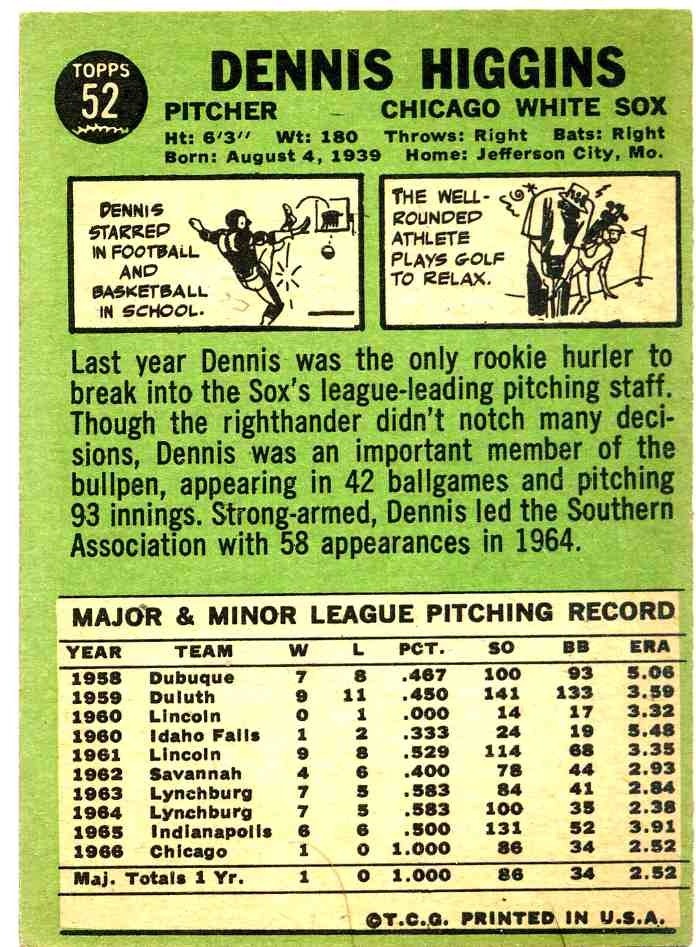
#52 Dennis Higgins - Chicago White Sox Pitcher.


Dennis Higgins is featured on his first solo card in this set. Higgins hit the ground running in the Majors. His '66 stats are very impressive for a reliever. He pitched in 42 games, starting in one, saving 5 and with a 2.52 ERA. He went on to see alot of work for the Senator in '68 and '69 and with the Indians in '70. His career ended with St Louis in '72. Relievers didn't get much respect until the mid 70s with pitching counts making their role more prominent. That's when they started getting national attention. Only the World Series teams seemed to have relievers that national audiences really noticed. Fans saw pitchers like Larry Sherry, Ron Perranoski, Moe Drabowsky, Joe Page, Bob Kuzava be called on to save a team's season in the clutch and respond in heroic fashion. The Higgins' of the league on teams that never made it to a 90 win season didn't get much recognition unfortunately.

The White Sox cards in the '67 set must have been a little confusing for fans at the time. The White Sox were one of those teams that changed their uniforms, often and I mean, often. This did not really begin to kick in until 1967. Higgins is featured in the '66 uniform which is still like the Go GO White Sox uniforms of the 50's. '67 featured a navy blue tinge to the road and home jerseys in place of the black and white uniforms of the era Higgins is featured in here. This blog post has gone on long enough without me going into the 5 or 6 other changes in their uniforms up until 1991 so I will leave it at that.

This card never made much of an impact on me. The grass looks a little yellowish and it is a standard spring training photo from probably 1966.

Higgins had cards in the '66, '67, '68. '69, '71 and '72 sets.

Random thought. Did Topps hire photographers to take photos, pay the teams for photos or paid for photos already taken by freelancers? Topps during this era broke from their tradition of taking photos during a season at local ball parks. Spring Training photos were not as common in the late 50s as they would become by the 60s. I feel it was a change in company policy to hire their own photographers and fly them to Florida or Arizona and work for a handful of weeks and be done with the whole project instead of keeping photographers busy all year taking photos at Shea or Yankee Stadium. They surely did both but spring training photos became characteristic of Topps cards until the early 90s when the demand for more action photos in the sets was elevated by Score and Upper Deck.

#51 Astros Rookie Stars Dave Adlesh & Wes Bales


Next is our 2nd rookie star card in the set and our first for the Houston Astros. These cards were hit or miss depending on the success of the prospects featured. I never liked them although I do like that the '67 card doesn't stick four prospects on it like in '63 or in the mid to late 70's sets. Dave Adlesh struggled to gain a toehold in the Majors. Astros looked at 3 or 4 catchers a year in those days and usually settled on John Bateman. Adlesh knocked around in the minors until 1970 but he never quite developed.

Wes 'Lee' Bales also had his struggles breaking into the Majors. He too went through various levels of the minors for years.

Bales was never featured on a card again while Adlesh appeared in the '68 set on his own card in the semi high number series and in the '69 set, posed without a hat and listed as being on the Cardinals although he never played for them in the Majors.

It's just a reminder how difficult a game it is to break into. If it's not injuries, it's the competition and in those days, the draft was an additional complication.

The card never appealed to me any more than the other Rookie star cards with the yellow borders, maybe even a little less with the terrible airbrush job done to Bales hat. They were no doubt trying to hide the fancy A of the Atlanta Braves on the hat. Bales debuted with them in '66.

Friday, March 3, 2017

#50 Minnesota Twin Outfielder - Tony Oliva -


Baseball spring training is heating up. I haven't yet come down from the high of seeing the Chicago Cubs not only in a World Series but winning one and to do it dramatically, coming back from down 3 to 1. I was content to enjoy that lone Wrigley Field  World Series win and hope for the best back in Cleveland. What followed, was a pleasant shock. Perhaps in hindsight, I shouldn't have felt that way. The Cubs struck out alot but they had a better team batting average than the Indians and a lower ERA than Cleveland. Stats are just stats, it's the wins that count but more often than not, the team with the better stats in a series win it in the end.

I was gravitating back to baseball and away from football before last season but my interest in this set has increased.

We're back to a card ending with a 5 or 0 so we have another contemporary star card from the mid 60s. Tony Oliva was one of the major Latin American stars of his day. Like in every sport, when one team is able to find first class talent in a new way, the others follow their lead. Tony Oliva was not just a great player, he was a pioneering great along with Orlando Cepeda and Felipe Alou. Technically, Oliva followed their lead but unlike them, Oliva was featured in eight straight All Star games as well as the '65 Series. Perhaps it was that the Minnesota Twins, like the San Francisco Giants, added more than one or two players from south of the border. Along with Oliva, the Twins had Cesar Tobar,Zoilo Versalles, Camilo Pasqual,and Sandy Valdespino on a team that took the Dodgers to 7 games in another nail biter of a fall classic in 1965,

Sure, Latin American players go back to the late 40s in the Majors but the trend of teams scouting in this area of the world didn't take hold until the 60s. Horace Clarke, Rico Carty, Manny Mota, Felix Mantilla, Juan Marichal and the three Alou brothers come to mind immediately. It is hard to imagine today's game without such talented players from Latin America taking it to the next level.

Oliva finished up as a career .300 hitter and perhaps the only reason he does not receive regular consideration for Hall of Fame honors is his somewhat short career. He played in 14 seasons but his career totals on offense are an apparent handicap for Hall honors.

Oliva was certainly one of the premiere players on a strong Minnesota ball club and few got higher recognition in his day than him.

The card features Oliva posing in the original Yankee Stadium with the trademark facade in the background. Other Twin players featured in this set were clearly taken in this location, if not the same day.

There is a change with Twin cards in the '67 set. A combo card has the banner on the bottom colored in deep purple block letters, Twin cards in the lower to mid series have the green lettering and, for some reason, the semi high Killebrew card has bright yellow letters for the tea name.

Tuesday, January 17, 2017

#49 Roy Face - Pittsburgh Pirates - Closer before the era of pitch counts

Pitch counting is something that was not so popular until around the time of the '69 Mets and their fleet of incredible young arms. Preserving their natural strength while they built their mechanics made sense. It made even more sense during the era of free agency which came about in the early 70's. Higher investments means higher concerns for a pitcher's throwing arm. A solid bullpen player wasn't as revered as it would become during the 70's with Rollie Fingers or Tug McGraw or Al Hrabosky. That brings me to one of the unsung bullpen aces of his day, Roy Face. All one has t do is look at the stats of the '67 Topps card to see how a career relief pitcher's best stats are ignored. A career 91-84 record and a 3.56 ERA is not very impressive when you look at it on the back of the card. The card looks like his one highlight was his winning 18 consecutive games in relief in 1959.

Digging deeper into the stats reveals Face's true worth as a pitcher. Three times he led the league in games finished and three times he led the league in saves. Face came up when the Pirates were struggling for wins. They had a string of 9 straight losing seasons until they named Danny Murtaugh their manager and that's when they became serious.

Face had a length career which spanned 3 decades and ended in his early 40's. I have admiration for Face since we're both the same height but he made the most of it as a professional athlete, having a career last 17 years in the Majors is impressive by every standard and it's doubly impressive when considering he was a 3 time All Star. He was featured strongly in the '60 World Series where he registered 3 saves in their 4 wins.

This Face card is a bit of an enigma. I want to think the photo was taken in a Major League ballpark but it looks more like a spring training field. The stands look to be a single tier and spring training photos weren't unusual for this set. The action behind Face is a nice change of pace from other posing photos are standard fare.

Much like the Tiger cards, the Pirates lettering is striking with a deep purple color super imposed against the photo. The black/white/gold color of the uniforms with that lettering in the foreground is a nice touch.

#48 Bill Freehan - Detroit Tigers - Why is he not in the Hall of Fame?

 I am not wild about turning this blog into an advocate forum for action. Debatable discussions distract from what the mission statement of my blog is which is to honor the 1967 Topps baseball card set.

However, I do ask the question with an impartial attitude. Why is Bill Freehan not in many discussions when it comes to being included in the Hall of Fame?

Perhaps his career batting average of .262 is a handicap when talking HOF but his 11 All Star appearances should make up for that. Maybe the era of heavy hitting and talented fielding catchers short changed Freehan when it comes to HOF honors. Whatever the reason. I do wonder. He had a tremendous career that maybe ended a little too soon at the age of 34.

Freehan made numerous appearances on Topps cards. He was well featured and for good reason with the All Star appearances. His cards are good for collecting if you want star cards that are not priced into orbit. Examples of these cards in the 1950's were Minnie Minoso, Bobby Thomson Ted Kluszewski and Gil Hodges. Bill Freehan is an example for the 1960's. There's more of course but I'll cover them when they come up.

As for the card, it's clearly a Spring Training photo. It features a good pose instead of a dull head and shoulders photo. The striking color of the letters works well with the green turning yellow grass field in the background. I wonder if the color of the field in most of the photos featuring Tiger players inspired the use of the purple letters.

The signature is somewhat obscured by the grass background. The back of the card isn't shy about the real reason Freehan was a regular all star. His career fielding percentage of. 993 and 38% caught stealing pct is still impressive. Johnny Bench, Carlton Fisk and Gary Carter didn't manage career averages as high as Freehan did with those two stats. All three are in the Hall of Fame by the way.

Wednesday, August 10, 2016

Evolution of a Baseball Fan

Ever, even for a fleeting moment, wondered what it would be like to love watching a sport but not feel an emotional attachment to the success of one over an other? Sure, this is a common if you do not feel an affinity to a sport you just happen to be watching but what if you were a fan of a team, lost interest, but still love the game?

I'm sure this happens to some. I was an avid Yankee fan since 1986.I suffered through the obsessive overbearing whims of Steinbrenner. All but two players from the '88 team were still left by 1990 and that was one of the worst teams in the club's history.

The Steinbrenner "agreement" to not be involved in day to day operations led to a rebirth of the team's fortunes. The 1994 Yankees did something I never dreamed could happen to a Yankee, team, they swept an entire West coast trip. I believer they were 11-0 on the trip. Just 4 years earlier, the Yankees couldn't even compete against Oakland. By August 11, 1994, the Yankees, though losing to the Blue Jays in extra innings, finished the day well in first place. The Yankees in '93 may still have the record for most times being in a first place tie without ever leading the division.

I didn't cry over the '94 strike but it did change how I felt about the game. If I were rooting for a team that was having a lousy season, I might have felt different but I longed to see the Yankees dominate like they did before my time. The day had come, but it still never arrived.

I won't go over what happened after the strike. It's clear what happened, The size of the market seemed to dictate the success of a club more than the play on the field. Over time, it became more obvious as player salaries were free to grow to limitless heights. These heights could be reached and teams can still build around the player on large market teams. Smaller markets, get the big start and he's like a giant stuck on a Triple AAA roster playing in the Majors.

The Yankees rose to heights they may have never reached. 125-50 record including the post season in 1998 may be the greatest season they ever had. It has to rival 1927 or 1961 with a record like that. Salaries really began to explode in the 2000's and the difference in quality of talent between large and small markets was blatant. The league found a cheesy wealth redistribution scheme to help level the talent out around the league. It's cheesy because as a team benefits from that money and becomes good, they cease to be a major beneficiary of the funds. The team shines for 2 or 3 years then plummets for the net 8 to 10. I see the Marlins,Reds,Rays,Phillies all experience this and I believe I am seeing the Royals begin to go through this. Is it fair? No, but that's the point of salary caps and they don't have that in the Majors.

So, being disgruntled over the business end of MLB and dispassionate about a team which no longer has an identity because it no longer has any homegrown talent playing a vital role in their success, I am left with, the love of the game itself. I see a player, his talent, what he can contribute to a team but no longer care which team. PEDs are a nice distraction from what I feel is a chronic decaying issue in terms of the competitiveness of MLB.

So, the game. The game itself. Put one on, the strategy is there from pitch to pitch. How a pitcher tries to trick a batter, how the batter tries to out  fox the fox. Where the ball ends up if hit, how it's fielded, where do you throw it if two are on? Is the runner taking an advantage of an outfielder with a weak arm or is he taking a chance with someone strong out there who could throw from right field to 3rd base with one authoritative bounce? If you're a manager, do you go with the right to right matchup late in the innings or risk going right to left just to bring your closer in who happens to be lefthanded? How long do you go with a pitcher who doesn't have his curve working that day? How long before you learn that pitcher doesn't have the curve? I could go on for an entire book of questions like this. The chess game that happens in every baseball game and it's all there if you are paying attention.

The game is the same. My love of teams is dead but the game lives on.

Saturday, August 6, 2016

#47 Ken McMullen - Washington Senators - A Solid Ballplayer.


This is another card that never made it beyond being noticed from all the rest common cards in the '67 set. Looking at this card now, I find the darkened sky interesting and I can't begin to guess where this photo was taken. That towering sign looks like something you'd see in a big league stadium hawking Roy Rogers chicken or Pabst Blue Ribbon beer. For some reason, I want to say that's Memorial Stadium, home of the Baltimore Orioles because it looks like you can see trees in the distance. The distance looks like beyond the outfield wall.

The time of day this picture looks to be taken makes the image unique for this set. It may just be the moments before an impending spring or summer storm was to strike or just a plain ole cloudy day. But still, unique for this set.

The W logo denoting Washington, for the Washington Senators, was meaningless to me as a boy. It was some years later that I learned that both the Minnesota Twins and the Texas Rangers were both former Washington Major League baseball clubs.

I honestly knew nothing about Ken McMullen's career before reaching his card in this blog. McMullen had a lengthy career,enjoying the bulk of his playing time with Washington.

He had an average .248 batting average and was a rare infield with some power. Eight years of double digit home runs was not the norm for infielders in the 60's. Bobby Richardson, Jim Gilliam never did it. Brooks Robinson managed double digit home runs 11 times in his career.

McMullen showed good power and good fielding enough to hold down a regular job as a starter during his prime with the Senators and Angels. He was a quality bench player for the Dodgers from '73 to '75 before finishing his career with the A;s and Brewers. A solid career in the Majors even if it was overshadowed by the headline grabbing stars.

#46 Lindy McDaniel - San Francisco Giants. What Faith and Good Attitude will do for you.

 Up next is a pitcher who, some would call a journeyman for appearing on 5 teams but it was 5 teams over the course of 20 years, Lindy McDaniel.

McDaniel is a player I came to learn more and more about as I grew older. As a kid, I saw this card and it was like looking at hundreds of others in the set. Only Giant cards I cared about were McCovey's, Mays' and Jesus Alou's who when I was a boy thought it was pronounced the same as Jesus Christ.

I remember reading either in Jim Bouton's Foul Ball or Was It Something I Said how McDaniel was someone who wore his religion on his sleeve. I remember Bouton writing that he was perhaps annoyed by that in his short time teammate. (Both were on the '68 Yankees team). I may be wrong but I don remember his mentioning McDaniel's deep faith which clearly served him well in his career and I would hope, his life.

McDaniel put in the time in the Majors. 21 years, 987 games pitched, 2139 innings pitched. Throughout all of those years, he never pitched for a team that made the post season but he managed 141 wins, mostly in relief. His finest stint came with the Yankees. by then, in his early to mid 30's, he hit a groove, with a 2.89 era and had a 38-29 record for the Yankees. He went on to round out his career with the Kansas City Royals who hadn't yet become the force they would become in the late 70's.

Anyone who can roll along in the Majors for that long must be blessed with good health and a good attitude and for many, the best way to reach that attitude is a strong belief system.

As I said, this card was run of the mill to my younger eyes. San Francisco Giants might as well have been playing in a different country when you're a Jersey kid. I never saw their games and I grew to loath the team in 1989 for knocking out the Cubs decisively in the National League Championship Series.

The team logo on the hat, and road jersey looks plain and uninteresting on this card. The green lettering for the team name wasn't eye grabbing. The picture looks to be taken on a spring training field. There's nothing but a barren blue sky, a dull looking wall and grass. Lindy looks good in the picture, the pose is standard had he pitched for the Yankees and were featured with them, it would have made an impact but, the Giants?


#45 Roger Maris - St Louis Cardinals (Pictured with the Yankees)

 Here is the first star card (but I guess it could be called semi star card) I had that I saw regularly because I was allowed to have the doubles in my own collection.

When I was a boy, I was an avid Yankee fan. My Italian-American parents had Sinatra playing in the house often (records in those days) and the majestic resonance of his voice somehow made me think of the Yankee logo even before I started to follow the game when I was 9 years old. When I started watching them, and heard "New York,New York" echo in the background during a telecast, that sense reawakened in me from when I was too young to understand the sport.

Roger Maris' '67 card was not only a double but it was a triple. I had several. Looking at the card, it's clear Maris is pictured in a Yankee uniform and while I knew, Cards, meant Cardinals (says as much on the back) I liked to pretend this was a Yankees card and Cards simply meant ,Baseball Cards. No disrespect of course to the World Series champs of the '67 season but my love of the Yankees and especially their heritage out shined all other teams in those days. The Yankees I watched were usually disappointing. The team in the 80's won more regular season games than any other team in the Majors, but they accomplished no championships and when I was watching them, they couldn't outlast other teams to make it into the playoffs. I fell back, naturally on the team's heritage. Hence, what made this card great. The single season home run king with 61 in '61.

I think time has been kinder to Maris' 61 in '61. At the time, there was squabbling over the length of the season being longer for him to achieve the goal of passing Ruth. That seems minor now since his record has been broken repeatedly by players who have been suspected of using PEDs. I can't say I share in the media hysteria over PED usage but to say that hasn't left a major taint on players and records set by said players is an understatement. None of the players that past Maris are in the Hall of Fame and neither is poor Maris but definitely not because of performance enhancing drugs allegations.

This blog could go on for thousands of words if I wanted to get into his start in Cleveland, over to KC and how the Kansas City Athletics seemed to be a Major League farm club to the New York Yankees. Seemed like, every time the Yankees, wanted to unload a vet for a prospect or a quality player, the A's were more than happy to accommodate them. Jerry Lumpe, Norm Siebern, Enos Slaughter, Hank Bauer, Billy Martin were all KC bound when the Yankees dropped them. Hector Lopez, former rookie of the year Harry Byrd, Enos Slaughter(resigned after releasing Rizzuto), Bobby Shantz, Roger Maris all ended up heading to New York from the Athletics. Those are just off the top of my head but as I said. This post would be a field of words if I went into detail. The point is Maris was a Yankee and his impact was immediate and lasting. A 4 time all star and back to back MVP. When he was healthy, there was no one better. The problem is that he never really was the same player after the injuries got him. His last season of near regular work would be the last time the Yankees appeared in a World Series for over a decade, 1964. Losing his power, left an ailing Mantle unprotected in the lineup and the aging sqaud collapsed in '65. Rebuilding started in '66 with new President Michael Burke and new GM Lee MacPhail at the helm. The casualties had to be the old guard. The Yankees fans came to love but were shadows of their former selves. If they weren't retiring, they were traded or released. Maris by '66 was traded to the Cardinals for Charley Smith. A largely unknown utility infielder. If I was a kid in those days, I would have been disgruntled to say the least.

Maris' totals with the Cardinals were respectable and much better than his final years with the Yankees. He went on to two pennants with the St Louis. Was an invaluable presence in the '67 series, collecting 10 hits in 26 at bats. His fortunes, like the Cardinals fortunes were not nearly so valuable in '68. The Tigers outlasted the dominant Cardinal pitching and Maris, in his last plat appearances managed on only a .158 average. 3 hits in 19 at bats for 1 RBI.

As I said, this card had a special place in my collection. A card of one of the memorable Yankees from when they were champions. Clearly, it features Maris in a Yankee uniform. Topps liked to use what pictures they could and this one worked because we don't see the Yankee logo on  the hat, just under the bill. The low open air pat of the original Yankee Stadium is visible in the background. It's anyone's guess what year the photo was taken. I think Maris looks younger (and thinner) than how he looked on the '66 and '68 Topps cards.

Radio personality, Jean Shepherd once said during his radio show that he felt that the Yankees of the early 60's were getting offered a few too many speaking engagements which meant they were having a few too many free dinners. They might have gotten a little too heavy and while people freely buy new clothes, they seldom buy new underwear and the weight and constriction caused by their older now ill fitting underwear affected their playing. Maybe he had something there.....

#44 Joe Nuxhall Pitcher Cincinnati Reds from a 15 year old rookie to a 37 year old vet.


I can't imagine any Reds fan not being enthused with having this classic card. Not only was Nuxhall a fan favorite player, he was also their radio/TV color commentator for literally decades after retirement. His rough voice was often paired with play by play man Marty Brennaman.

Nuxhall's initial claim to fame occured during the World War Two years. A mere 15 years old, probably with knees shaking and nerve swallowing when he got the call to take the mound at the Reds old par Crosley Field, Nuxhall debuted. I only assume he was nervous. He managed only 2 outs while giving up 5 earned runs in a 18-0 route loss to the Cardinals. You'd think with the game already well out of hand in the top of the 9th, the pressure might have been off but all the Reds arms were feeling it against that Cardinal team which went on to win the World Series that year.

Nuxhall was done in the Majors for a good many years after that appearance but to prove his drive was still in tact, he came back to have a long respectable career with usually under performing teams. It was just his luck to miss out on the Reds trip to the Series in '61. The Reds traded him off before that season but would bring him back for keepsin June '62

The southpaw was a 2 time All Star and had longevity in the league. What makes this '67 Topps card special for Reds fans is, that it's his last card. Nuxhall finished his playing career in '66 and was on to broadcasting while kids were pulling his cards from the $.05 packs.

I never cared much for this card. I never liked the pea green color used for the team name and I felt the picture wasn't striking. There's plenty of sky, what looks like drying grass during the early stages of an extended drought and, frankly, Nuxhall's graying hair in his mid 30's makes me equally self conscious having the same salt and pepper, I'll call it quality in my hair.

I've grown to appreciate this card more though, if only because it is one of the many final cards of a notable player's career and checkout the uniform! A vest with what looks like a windbreaker under the vest.

I recommend Reds fans to pick THIS card up. It is a great piece for any Red fan. Not only is it Nuxhall's last card, it's not so expensive. A nice piece of team history that is both affordable and valuable to a fan.

Back in the Swing of Things

This has been in the running as one of the least updated actively used by blogger blog pages on the internet in recent history.

Various things always happen. The weight of challenges isn't always easy to gauge before taking them on. If you find it hard to maintain balance, then the true you shows itself because you are tested and the people who pass this exam know how to meet life on its terms when it's necessary to do so, and make things happen and work toward goals while managing to get by.

That said, I've been busy working on a writing project (not online because it's experimental),looking after my elderly parents and trying to earn a buck and pay my bills. The experiment is on hiatus now, my parents now have my sister and I looking after them and I'm now looking for a job to earn a buck to pay my bills.

That's my summation of my recent history though I did manage to post on the hotly anticipated (but ultimately neglected) Topps Heritage set devoted to the 1967 Topps card design. Topps tried to address modern design interest for fans (action photos, candid pictures, etc) with original (poses from players either in spring training parks or big league stadiums of previous years).

My collection of '67 Topps card photos is back on my new used laptop and I'll be good to go soon/

But the love of the game, baseball. That's what made my return to this inevitable. The simple pleasures of watching the games, the happy memories of playing, enjoying them on TV, the handful of games I've seen in person and of course, card collecting. I am blessed with happy memories of childhood, all children should be so blessed and I hope as many as possible are in today's day of age.

Wednesday, March 23, 2016

2016 Topps Heritage Review

Since this blog is about the classy appearance of a vintage Topps set, I thought I would spend a few words on Topps' latest Heritage set since it honors the appearance of the '67 set.

About 15 years ago, Topps saw the need to fill the collector's demand for vintage looking sets. Other manufacturers jumped in like Fleer Tradition and whatever Upper Deck was trying to do with their vintage looking designs. Since Topps was the only vintage card company to create more than a handful of sets, their series proved to be the most successful. In '01, they started with '52 and now that it's '16, we are up to 1967.

All I ever wanted from these Heritage sets were the right pictures of players being used for these cards. In the 50's and 60's, action shots from games came from newspaper photographers, hence they were either in black and white or they painted the black and white photos over like the World Series cards or the player highlight cards from '59 or '61 or '62. Topps had to make do with asking players to pose for their photographers either during training camps in the '60s or before games as they did regularly in the '50s. Topps Heritage dropped the ball in this regard for me early. I became deeply disappointed (well as deeply disappointed as one could be over baseball cards) to see the following below.

Instead of these from 1957 to the left,


 Topps made SOME cards like this on the left.


Granted the majority of the cards were close to what the originals represented (see right) but any action shot used ruined the authenticity of the original

Now, Topps has acknowledged this and here are three examples. 

 You can't go wrong with these cards if you are looking for accurate images to match the card design because it is impossible to capture the feel of those old cards without these types of images. Using action shots makes these vintage designs look like what they are with those photos, new cards trying to look old and not doing a good job of it.
Granted, not everyone is a purist and feels the same as I do so Topps decided to add cards with action shots as short print parallels to the types of cards above. 
 I don't hold these types of cards in high regard but they are not the common cards in the set. 

A pet peeve in these sets cards where players appear to be in candid shots.
The rookie dual player cards capture the look and feel as the originals as well. Since I am blowing this up with photos, I ask that anyone wanting to compare to please see the other cards featured on my blog. 
Other modernized variations can be found with the World Series highlight cards. The originals use black and white photos to highlight the games of the one sided '66 World Series (Baltimore swept LA) 
The common card captures the feel well with black and white images but there are rare variations with color photos as well. 
The color photo variant is definitely not the common version in this set. 
What I don't see are the checklist cards. The originals feature a prominent player in the top left corner, bright red letters denoting the type of card it is and the series and a yellow box listing the players and card numbers. 
Unfortunately, the great team cards are nothing like the originals in the Heritage set. The originals featured the team posing for a team photo and the card is filled out with a color. Some with blue, some with red, most seemed to be yellow, below is what they did. Candid shots of some players after a victory. Instead of the backs containing interesting head to head stats with other teams, you just get a checklist of the players from the team included in the base set. These types of team cards are more in keeping with team cards from the 80's. Either the checklist was on team cards or manager cards.


The combo cards feature candid shots of two players during games for the most part. That's not in keeping with the originals which were players posing together, usually at training camps.


As always with Heritage cards, there's tons of variants, either different images being used, either different cardboard stock, either multiple cards of single players, autographs, jersey or bat cards.Flashback cards featuring players from the '67 season and on and on. 

All and all, as a purist, the cards aren't as much a disappointment as older sets but there's still enough missing that makes me wish it could have been better. 


Tuesday, November 11, 2014

# 43 Chico "Super Sub' Salmon of the Cleveland Indians

Next in the set is the Indians utility infielder, Chico Salmon. I never heard about or knew much of anything about this player. This is partly why I do this blog. Learning a little more about baseball's past is a hobby. Learning about the players is a massive part of that. Every player who makes it to the Majors, excelled in the profession. If they got up there and had batting averages like Mario Mendoza or Wayne Tolleson, they still made it to the peak of their profession.

The Panamanian born Chico Salmon is one such player. Salmon neverSalmon was a fill in for most of his 9 year career in the Majors. He earned the nickname 'Super Sub' while in Cleveland. Cleveland fans are alot like Phillie and Blue Jay fans prior to the '94 strike. Players were able to settle in with a team and play out a career there. This allowed fans and the local press to learn more about the players they were rooting for. This is something missing in the game today. Fans have to root more for the team and less for players because the majority of them don't last long on the same teams (watch out for that Royal fans)

Salmon didn't have the greatest career batting average (.249) but this could be due to his lack of regular play. Salmon was an instinctive base runner and a quality infielder.

Salmon spent five full seasons with Cleveland. The Indians left him unprotected in the expansion draft and the Seattle Pilots claimed him. He was traded to the powerhouse Orioles before ever appearing in a Pilot game and that spared him from playing on one of the worst teams in the league to the AL pennant winning Orioles. He went on to make appearances in the first ever NLCS in '69, the '69 Series against the Mets and getting his sole World Series hit for the 1970 Champion Orioles.

Salmon saw less and less work with the Orioles in '71 and '72. He was done in the Majors toward the end of 1972 at the age of 31.

He remained devoted to the game and was a part of it up until his untimely death from a heart attack at the age of 59.

Topps made plenty of cards featuring Chico Salmon. He had a card every year of his career. '64 to '72. He even had a '69 Topps card stating he was on the Pilots.

His '67 card didn't stand out from the rest. I saw it as a common card. Commons never stood out. The Beckett Baseball Card Monthly was a regular purchase and the cards that were named, were the cards I looked at in the set. The rest were lumped in together as commons, all with the same price based on where they were placed in the set.

I find Salmon's card interesting now because it looks like the photo of him was taken in Cleveland Municipal Stadium. I don't see the white facade of Yankee Stadium lining the roof, I don't recognize the scoreboard in the back, and the stands are too large to be a spring training facility.  It's rare finding a photo of a player not from Florida, Arizona or New York in this set.

#42 New York Mets Team Card, the Miracle wasn't on the radar yet.

Team cards were a thing in the past by the late 1980's so I loved seeing them in this set. They were foreign to me and that made them more fun to look at.

The '67 Topps team cards, feature the team embedded in a sea of color. Most of the cards were yellow but later cards feature red backgrounds or no background at all.  The team name colors remained uniform with the single player cards from the team. The Mets with it's striking purple look well in the yellow.

The idea that the Mets would be the team to beat in the Majors only two years later (three years after the photo taken, had to be laughable back then.  The '66 stats on the back say t all. They had alot of young pitchers coming up but Ron Hunt led the team in hits with only 138. The ERA leader was Ribant with a pedestrian 3.21. Ken Boyer had only 61 RBI and Kranepool had only 16 home runs, but they were both good enough to lead the team in '66.

The '66 Mets were still in the hands of their second manager, Wes Westrum. They appointed Casey Stengel by this time up and out of uniform.  'Basement Bertha', Joan Payson was still not rewarded for her and her husband's efforts to bring National League baseball back to New York. Her time would come though in '69. Much of the lineup was different by then but the young pitchers, McGraw, Seaver, Koosman were coming along. Nolan Ryan would find himself fully with the Angels in the 70's.

Just a note on the Mets uniform. I don't know how well they were received at the time but talk about a mashup job. Take Dodger blue, mix it with Giant orange and throw in Yankee pinstripes. Then put them in the rat infested Polo Grounds until their Flushing, Queens stadium was done and ready to go. They had devoted fans though and they still do. I never was a Met 'fan' but I admire their devotion. And that goes double for the fans from day one and stood by them during the years when Ed Kranepool and Ron Swoboda was seen as their Mickey Mantle and Roger Maris