This has been in the running as one of the least updated actively used by blogger blog pages on the internet in recent history.
Various things always happen. The weight of challenges isn't always easy to gauge before taking them on. If you find it hard to maintain balance, then the true you shows itself because you are tested and the people who pass this exam know how to meet life on its terms when it's necessary to do so, and make things happen and work toward goals while managing to get by.
That said, I've been busy working on a writing project (not online because it's experimental),looking after my elderly parents and trying to earn a buck and pay my bills. The experiment is on hiatus now, my parents now have my sister and I looking after them and I'm now looking for a job to earn a buck to pay my bills.
That's my summation of my recent history though I did manage to post on the hotly anticipated (but ultimately neglected) Topps Heritage set devoted to the 1967 Topps card design. Topps tried to address modern design interest for fans (action photos, candid pictures, etc) with original (poses from players either in spring training parks or big league stadiums of previous years).
My collection of '67 Topps card photos is back on my new used laptop and I'll be good to go soon/
But the love of the game, baseball. That's what made my return to this inevitable. The simple pleasures of watching the games, the happy memories of playing, enjoying them on TV, the handful of games I've seen in person and of course, card collecting. I am blessed with happy memories of childhood, all children should be so blessed and I hope as many as possible are in today's day of age.
Saturday, August 6, 2016

Wednesday, March 23, 2016
2016 Topps Heritage Review
Since this blog is about the classy appearance of a vintage Topps set, I thought I would spend a few words on Topps' latest Heritage set since it honors the appearance of the '67 set.
About 15 years ago, Topps saw the need to fill the collector's demand for vintage looking sets. Other manufacturers jumped in like Fleer Tradition and whatever Upper Deck was trying to do with their vintage looking designs. Since Topps was the only vintage card company to create more than a handful of sets, their series proved to be the most successful. In '01, they started with '52 and now that it's '16, we are up to 1967.
 All I ever wanted from these Heritage sets were the right pictures of players being used for these cards. In the 50's and 60's, action shots from games came from newspaper photographers, hence they were either in black and white or they painted the black and white photos over like the World Series cards or the player highlight cards from '59 or '61 or '62. Topps had to make do with asking players to pose for their photographers either during training camps in the '60s or before games as they did regularly in the '50s. Topps Heritage dropped the ball in this regard for me early. I became deeply disappointed (well as deeply disappointed as one could be over baseball cards) to see the following below.
Instead of these from 1957 to the left,

 Topps made SOME cards like this on the left.


Granted the majority of the cards were close to what the originals represented (see right) but any action shot used ruined the authenticity of the original


 You can't go wrong with these cards if you are looking for accurate images to match the card design because it is impossible to capture the feel of those old cards without these types of images. Using action shots makes these vintage designs look like what they are with those photos, new cards trying to look old and not doing a good job of it.
 I don't hold these types of cards in high regard but they are not the common cards in the set.


 Unfortunately, the great team cards are nothing like the originals in the Heritage set. The originals featured the team posing for a team photo and the card is filled out with a color. Some with blue, some with red, most seemed to be yellow, below is what they did. Candid shots of some players after a victory. Instead of the backs containing interesting head to head stats with other teams, you just get a checklist of the players from the team included in the base set. These types of team cards are more in keeping with team cards from the 80's. Either the checklist was on team cards or manager cards.

About 15 years ago, Topps saw the need to fill the collector's demand for vintage looking sets. Other manufacturers jumped in like Fleer Tradition and whatever Upper Deck was trying to do with their vintage looking designs. Since Topps was the only vintage card company to create more than a handful of sets, their series proved to be the most successful. In '01, they started with '52 and now that it's '16, we are up to 1967.
 All I ever wanted from these Heritage sets were the right pictures of players being used for these cards. In the 50's and 60's, action shots from games came from newspaper photographers, hence they were either in black and white or they painted the black and white photos over like the World Series cards or the player highlight cards from '59 or '61 or '62. Topps had to make do with asking players to pose for their photographers either during training camps in the '60s or before games as they did regularly in the '50s. Topps Heritage dropped the ball in this regard for me early. I became deeply disappointed (well as deeply disappointed as one could be over baseball cards) to see the following below.
Instead of these from 1957 to the left,

 Topps made SOME cards like this on the left.

Granted the majority of the cards were close to what the originals represented (see right) but any action shot used ruined the authenticity of the original
Now, Topps has acknowledged this and here are three examples.


 You can't go wrong with these cards if you are looking for accurate images to match the card design because it is impossible to capture the feel of those old cards without these types of images. Using action shots makes these vintage designs look like what they are with those photos, new cards trying to look old and not doing a good job of it.
Granted, not everyone is a purist and feels the same as I do so Topps decided to add cards with action shots as short print parallels to the types of cards above.
I don't hold these types of cards in high regard but they are not the common cards in the set.
A pet peeve in these sets cards where players appear to be in candid shots.

The rookie dual player cards capture the look and feel as the originals as well. Since I am blowing this up with photos, I ask that anyone wanting to compare to please see the other cards featured on my blog.

Other modernized variations can be found with the World Series highlight cards. The originals use black and white photos to highlight the games of the one sided '66 World Series (Baltimore swept LA)
The common card captures the feel well with black and white images but there are rare variations with color photos as well.


The color photo variant is definitely not the common version in this set.
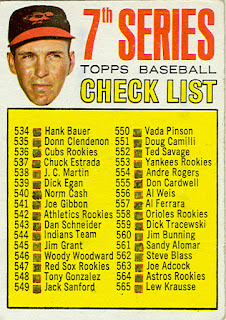
What I don't see are the checklist cards. The originals feature a prominent player in the top left corner, bright red letters denoting the type of card it is and the series and a yellow box listing the players and card numbers.

 Unfortunately, the great team cards are nothing like the originals in the Heritage set. The originals featured the team posing for a team photo and the card is filled out with a color. Some with blue, some with red, most seemed to be yellow, below is what they did. Candid shots of some players after a victory. Instead of the backs containing interesting head to head stats with other teams, you just get a checklist of the players from the team included in the base set. These types of team cards are more in keeping with team cards from the 80's. Either the checklist was on team cards or manager cards.
The combo cards feature candid shots of two players during games for the most part. That's not in keeping with the originals which were players posing together, usually at training camps.
As always with Heritage cards, there's tons of variants, either different images being used, either different cardboard stock, either multiple cards of single players, autographs, jersey or bat cards.Flashback cards featuring players from the '67 season and on and on.
All and all, as a purist, the cards aren't as much a disappointment as older sets but there's still enough missing that makes me wish it could have been better.
Tuesday, November 11, 2014
# 43 Chico "Super Sub' Salmon of the Cleveland Indians
Next in the set is the Indians utility infielder, Chico Salmon. I never heard about or knew much of anything about this player. This is partly why I do this blog. Learning a little more about baseball's past is a hobby. Learning about the players is a massive part of that. Every player who makes it to the Majors, excelled in the profession. If they got up there and had batting averages like Mario Mendoza or Wayne Tolleson, they still made it to the peak of their profession.
 The Panamanian born Chico Salmon is one such player. Salmon neverSalmon was a fill in for most of his 9 year career in the Majors. He earned the nickname 'Super Sub' while in Cleveland. Cleveland fans are alot like Phillie and Blue Jay fans prior to the '94 strike. Players were able to settle in with a team and play out a career there. This allowed fans and the local press to learn more about the players they were rooting for. This is something missing in the game today. Fans have to root more for the team and less for players because the majority of them don't last long on the same teams (watch out for that Royal fans)

Salmon didn't have the greatest career batting average (.249) but this could be due to his lack of regular play. Salmon was an instinctive base runner and a quality infielder.
Salmon spent five full seasons with Cleveland. The Indians left him unprotected in the expansion draft and the Seattle Pilots claimed him. He was traded to the powerhouse Orioles before ever appearing in a Pilot game and that spared him from playing on one of the worst teams in the league to the AL pennant winning Orioles. He went on to make appearances in the first ever NLCS in '69, the '69 Series against the Mets and getting his sole World Series hit for the 1970 Champion Orioles.
Salmon saw less and less work with the Orioles in '71 and '72. He was done in the Majors toward the end of 1972 at the age of 31.
He remained devoted to the game and was a part of it up until his untimely death from a heart attack at the age of 59.
Topps made plenty of cards featuring Chico Salmon. He had a card every year of his career. '64 to '72. He even had a '69 Topps card stating he was on the Pilots.
His '67 card didn't stand out from the rest. I saw it as a common card. Commons never stood out. The Beckett Baseball Card Monthly was a regular purchase and the cards that were named, were the cards I looked at in the set. The rest were lumped in together as commons, all with the same price based on where they were placed in the set.
I find Salmon's card interesting now because it looks like the photo of him was taken in Cleveland Municipal Stadium. I don't see the white facade of Yankee Stadium lining the roof, I don't recognize the scoreboard in the back, and the stands are too large to be a spring training facility. It's rare finding a photo of a player not from Florida, Arizona or New York in this set.
 The Panamanian born Chico Salmon is one such player. Salmon neverSalmon was a fill in for most of his 9 year career in the Majors. He earned the nickname 'Super Sub' while in Cleveland. Cleveland fans are alot like Phillie and Blue Jay fans prior to the '94 strike. Players were able to settle in with a team and play out a career there. This allowed fans and the local press to learn more about the players they were rooting for. This is something missing in the game today. Fans have to root more for the team and less for players because the majority of them don't last long on the same teams (watch out for that Royal fans)
Salmon didn't have the greatest career batting average (.249) but this could be due to his lack of regular play. Salmon was an instinctive base runner and a quality infielder.
Salmon spent five full seasons with Cleveland. The Indians left him unprotected in the expansion draft and the Seattle Pilots claimed him. He was traded to the powerhouse Orioles before ever appearing in a Pilot game and that spared him from playing on one of the worst teams in the league to the AL pennant winning Orioles. He went on to make appearances in the first ever NLCS in '69, the '69 Series against the Mets and getting his sole World Series hit for the 1970 Champion Orioles.
Salmon saw less and less work with the Orioles in '71 and '72. He was done in the Majors toward the end of 1972 at the age of 31.
He remained devoted to the game and was a part of it up until his untimely death from a heart attack at the age of 59.
Topps made plenty of cards featuring Chico Salmon. He had a card every year of his career. '64 to '72. He even had a '69 Topps card stating he was on the Pilots.
His '67 card didn't stand out from the rest. I saw it as a common card. Commons never stood out. The Beckett Baseball Card Monthly was a regular purchase and the cards that were named, were the cards I looked at in the set. The rest were lumped in together as commons, all with the same price based on where they were placed in the set.
I find Salmon's card interesting now because it looks like the photo of him was taken in Cleveland Municipal Stadium. I don't see the white facade of Yankee Stadium lining the roof, I don't recognize the scoreboard in the back, and the stands are too large to be a spring training facility. It's rare finding a photo of a player not from Florida, Arizona or New York in this set.
#42 New York Mets Team Card, the Miracle wasn't on the radar yet.

The '67 Topps team cards, feature the team embedded in a sea of color. Most of the cards were yellow but later cards feature red backgrounds or no background at all. The team name colors remained uniform with the single player cards from the team. The Mets with it's striking purple look well in the yellow.
 The idea that the Mets would be the team to beat in the Majors only two years later (three years after the photo taken, had to be laughable back then. The '66 stats on the back say t all. They had alot of young pitchers coming up but Ron Hunt led the team in hits with only 138. The ERA leader was Ribant with a pedestrian 3.21. Ken Boyer had only 61 RBI and Kranepool had only 16 home runs, but they were both good enough to lead the team in '66.
The '66 Mets were still in the hands of their second manager, Wes Westrum. They appointed Casey Stengel by this time up and out of uniform. 'Basement Bertha', Joan Payson was still not rewarded for her and her husband's efforts to bring National League baseball back to New York. Her time would come though in '69. Much of the lineup was different by then but the young pitchers, McGraw, Seaver, Koosman were coming along. Nolan Ryan would find himself fully with the Angels in the 70's.
Just a note on the Mets uniform. I don't know how well they were received at the time but talk about a mashup job. Take Dodger blue, mix it with Giant orange and throw in Yankee pinstripes. Then put them in the rat infested Polo Grounds until their Flushing, Queens stadium was done and ready to go. They had devoted fans though and they still do. I never was a Met 'fan' but I admire their devotion. And that goes double for the fans from day one and stood by them during the years when Ed Kranepool and Ron Swoboda was seen as their Mickey Mantle and Roger Maris
#41 Joe Hoerner , south paw bullpen all star and Proto Robert Wuhl lookalike.
 I often compare faces in my mind. Some people focus on names, my mind works in images. With my mind working this way, I see Robert Wuhl when I see Joe Hoerner on this 1967 Topps baseball card.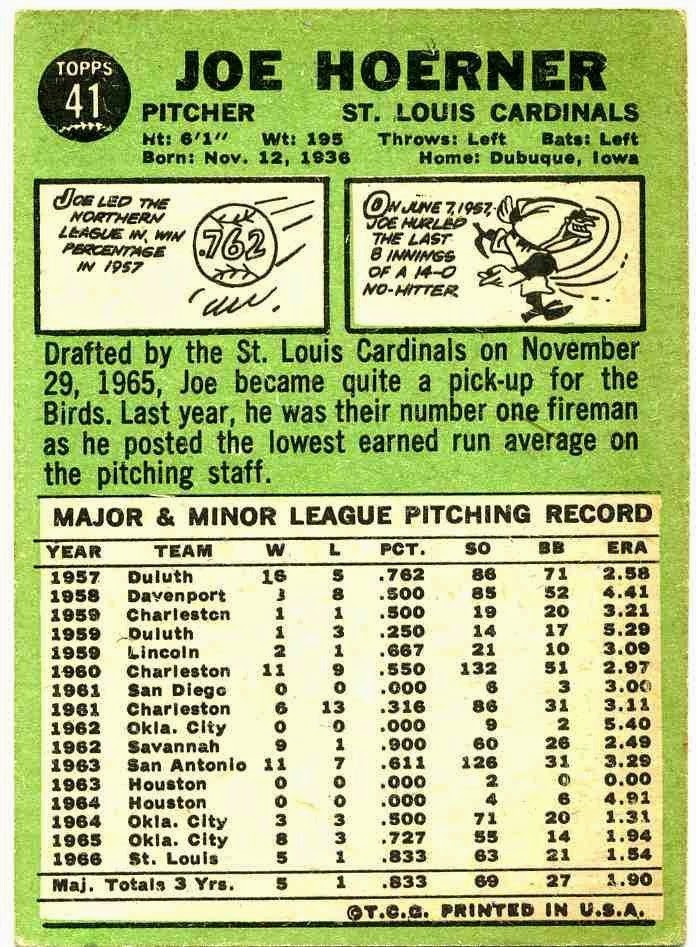
 I admit it, I may be the only person seeing it, but I do see it with the way my brain operates. Hoerner was bigger in physical stature but at the time, seeing Wuhl in movies like Bull Durham and Batman, I couldn't help but think that I saw him before and here is where I thought I saw his face. That's what I remember most about his '67 card. It has a standard head shoulder photo. Good color on the photo. Nothing looking washed out in the image.
Hoerner was late starting in the Majors and when he did it was with a very young Houston team. Hoerner was almost 27 when he debuted. This was due to health problems early in his pro career. Hoerner was a workhorse reliever and he had hitters baffled with his pitches. His ERA was excellent throughout his time in St Louis and even better when he went on to pitch for the Phillies. Hoerner was a part of the contentious trade involving Curt Flood. Flood refused to report and his fate in the Majors was all but sealed after that.
In 1970, Hoerner represented the Phillies in the All Star game as a left handed reliever. This was the days when starters would pitch 16 innings if they had to. A reliever making a name for himself was still a rarity. He hadn't saved many games, only 99 in a 14 year career, but when he did pitch he did his job well.
Hoerner went on to play for 5 major league teams and was one of the oldest players to appear in the National League game at that time in his career. His career ended as part of a depleted 1977 Reds bullpen.
Hoerner died in a farming accident. This article offers more information about the man too. Former Tiger pitcher, Mark 'The Bird' Fidrych died in a similar accident.
#40 Rick Reichardt and the mountain of hopes.
 Up next is another 'star' card or card of interest based on it's placement in the set. Topps cards with numbers like 10, 25, 40, 115, all have prominent players on them and Rick Reichardt at that time in his career was on that short list.
Reichardt was a highly touted college athlete who the Angels paid a fortune for. I imagine the media saw him as the second coming of Harry Agganis. A major college athlete who chose baseball over football. He fell well short of expectations for the Angels.
Reichardt was one of the young up and coming stars that Topps was confident would succeed. They made a slew of cards for Reichardt while they made cards of players like Lou Piniella sporadically. Topps weren't fortune tellers, they didn't predict where Piniella ended up and they overrated Reichardt out of the gate.
 This is not to say Reichardt wasn't a solid player who had a fairly successful career in the Majors. Reichardt was a righthanded left fielder with power. He had double digit home run seasons and early on in his career. In '68 he had 21 homers and 73 RBIs. He also struck out like a power hitter usually does.
He went on to play for four teams in ten seasons. He arguably had his best season in 1971 for the White Sox. The Sox were rebuilding from the solid teams they had throughout the 60's and Reichardt saw considerable work. He played in 138 games in '71, had 19 home runs, 62 RBI and got his strike out total down.
This is not a good looking card but I don't like how any of the Angel cards look. I did see alot of the Reichardt card growing up because I had a double of it. I didn't think too much of it because the player wasn't someone a kid, new to following the game would know about. Card has a good shot of the player with the original Yankee stadium stands and scoreboard, blurred in the background.
Friday, November 7, 2014
#39 Curt Simmons - former Phillie and Cardinal pitching great's last card.
Curt Simmons had a long and successful career pitching in the Majors and this is his final card. It is a timely choice for his final card because his career ended in October of '67. Simmons was a 5'10" lanky southpaw who., with Roberts, helped anchor the Phillies starting rotation. He won 17 games in 1950 as one of the Phillie 'Whiz Kids' though he did not appear in the Series that year. He spent 1951 in the service but returned to be an all star in '52, '53 and '57.
 Injuries caught up to him in '60 and during this time he was a 31 year old free agent. He was unemployed for all of three days before the Cardinals signed him. It wasn't long before he picked up where he left off in the mid 50's. In '64 he won 18 games for the pennant winning Cardinals. He earned a loss in his two starts in the World Series but gained a World Series ring.
Following the series, Simmons, 36 struggled to regain the form he had for much of his career. He went 9-15 for a .500 Cardinal team in '65. He split his time in 1966 with the Cardinals and Cubs and finished his career in '67 with the Cubs and Angels.
 Simmons had 20 major baseball cards made during his career dating back to 1949. Bowman made 7 of them and they were bought out after making their final set in 1955. The players who were regulars on the '1950's cards always grabbed my attention because even at an early age, I felt the older the card, the better. Collecting the latest rookie star card or the latest slick set was cheaper and easier to do (just by packs at the Thrift Drug store), Getting the oldies were harder. You needed to beg to go to a card show or a card store. I have fond memories of both of these places.
I admit, I never collected any of Simmons' cards. But I would have gladly if I were a Phillie fan living near Philadelphia. His cards would be easier to find, I'd know more about his history and best of all, I could afford them because Robin Roberts and Bob Gibson's cards were expensive, but Simmons' cards were affordable even though he was valuable to the same teams those pitchers played for.
This is a good looking card. It is closer than a standard head and shoulder shot of the player. But the photo used works well with the color of the Cubs lettering. The signature however is half lost in Simmons' hairline.
Again, I am feeling my age. Simmons didn't look like a young man in this photo. To a 9 year old, he looks every bit his age and then some; you'd add up on the back and then add 15 more years. But now, I am rapidly catching up to his retirement age. and I admire this man's longevity in the league.
Injuries caught up to him in '60 and during this time he was a 31 year old free agent. He was unemployed for all of three days before the Cardinals signed him. It wasn't long before he picked up where he left off in the mid 50's. In '64 he won 18 games for the pennant winning Cardinals. He earned a loss in his two starts in the World Series but gained a World Series ring.Following the series, Simmons, 36 struggled to regain the form he had for much of his career. He went 9-15 for a .500 Cardinal team in '65. He split his time in 1966 with the Cardinals and Cubs and finished his career in '67 with the Cubs and Angels.
Simmons had 20 major baseball cards made during his career dating back to 1949. Bowman made 7 of them and they were bought out after making their final set in 1955. The players who were regulars on the '1950's cards always grabbed my attention because even at an early age, I felt the older the card, the better. Collecting the latest rookie star card or the latest slick set was cheaper and easier to do (just by packs at the Thrift Drug store), Getting the oldies were harder. You needed to beg to go to a card show or a card store. I have fond memories of both of these places.I admit, I never collected any of Simmons' cards. But I would have gladly if I were a Phillie fan living near Philadelphia. His cards would be easier to find, I'd know more about his history and best of all, I could afford them because Robin Roberts and Bob Gibson's cards were expensive, but Simmons' cards were affordable even though he was valuable to the same teams those pitchers played for.
This is a good looking card. It is closer than a standard head and shoulder shot of the player. But the photo used works well with the color of the Cubs lettering. The signature however is half lost in Simmons' hairline.
Again, I am feeling my age. Simmons didn't look like a young man in this photo. To a 9 year old, he looks every bit his age and then some; you'd add up on the back and then add 15 more years. But now, I am rapidly catching up to his retirement age. and I admire this man's longevity in the league.
Subscribe to:
Posts (Atom)